A dependable factory is rarely defined by a polished website or a long list of product categories. The more useful clues appear in how a manufacturer handles materials, sampling, quality control, customization, production capacity, and communication. At YIJIA Optical, we believe that evaluating these details gives sports brands a clearer picture of whether a supplier can support a project beyond the first quotation.
For companies comparing custom sports goggles manufacturers, the goal is not simply to find a factory that can produce a sample, but to understand whether its processes can remain consistent as requirements become more demanding.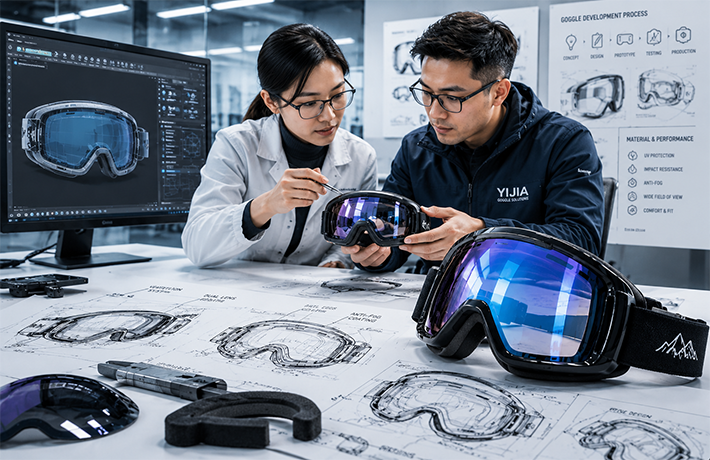
Experience matters because sports goggles involve several interconnected components rather than a single finished part. Frame flexibility, lens properties, foam density, strap construction, optical clarity, ventilation, and surface treatment can all affect the final product. A factory familiar with these variables is better positioned to discuss practical manufacturing limitations before they become production problems.
Production history can also provide useful evidence. YIJIA has more than 20 years of experience in the goggle industry and has handled more than 180,000 transactions. These figures do not replace technical evaluation, but they can provide context when combined with information about research and development, tooling, sampling, assembly, and mass production.
Another point worth examining is whether the supplier offers both OEM and ODM support. OEM work generally requires accurate execution of an established specification, while ODM projects may involve more discussion around construction, materials, appearance, and functional requirements. A factory capable of handling both models may provide a broader manufacturing pathway for brands at different development stages.
A reliable factory should be able to explain product specifications in concrete terms. Instead of relying on broad statements such as “high quality,” buyers can ask about lens materials, frame materials, foam construction, strap characteristics, optical treatment, dimensions, tolerances, and applicable customization options.
For anti fog sports goggles, compliance with EN ISO 18527-1 provides an objective benchmark for optical quality, impact resistance, and UV protection under snow-sport conditions. A factory that can reference this standard, rather than only offering a generic “anti-fog” claim, gives buyers a more verifiable basis for comparison.
Documentation is equally useful. Technical drawings, material descriptions, sample approval records, inspection criteria, and packaging specifications can create a shared reference between the factory and the customer. Clear documentation reduces the chance that a verbal adjustment made during development will be interpreted differently during mass production.
A production sample can demonstrate what a factory is capable of making once. It does not automatically show whether the same result can be reproduced across a larger order. This distinction is particularly important in sports eyewear because small differences in assembly, lens positioning, foam application, or frame molding may affect the finished product.
Quality control should cover incoming materials, production processes, assembly, appearance, and finished-goods inspection. The exact inspection points depend on the product, but a useful supplier should be willing to explain where checks take place and which specifications are considered critical.
Brands can also ask how nonconforming products are handled. A mature manufacturing process should have a defined way to identify defects, isolate affected units, investigate causes, and record corrective actions. The purpose is not simply to find defective products at the end; it is to create traceable information that can improve consistency throughout production.
Customization is often where the difference between a capable factory and a basic supplier becomes more visible. A custom sports goggles project may involve logo placement, colors, lens options, frame details, packaging, materials, or entirely new tooling. Each change can influence cost, production timing, minimum order quantities, and technical feasibility.
Communication should remain specific throughout this process. Instead of receiving only a price, customers should be able to discuss drawings, reference samples, material choices, packaging requirements, and revision points. A useful communication process makes technical information easier to verify before production begins.
It is also worth paying attention to how a factory responds to difficult questions. A supplier does not need to agree with every requested specification. Explaining why a certain structure may require modification, additional tooling, or another material can be more useful than simply accepting every requirement without discussion.
Reliability becomes easier to judge when several forms of evidence point in the same direction. A factory with established production experience, documented specifications, practical quality controls, responsive communication, and scalable manufacturing capabilities gives customers more information to evaluate than a factory relying mainly on promotional claims.
The same principle applies when reviewing anti fog sports goggles suppliers. Product performance should be considered alongside manufacturing consistency, material traceability, inspection procedures, customization support, and after-sales communication. A technically attractive sample has limited value if later production cannot maintain the agreed specifications.
For brands developing custom sports goggles, a sensible evaluation process can begin with a factory audit or capability review, followed by technical discussions, sample assessment, specification confirmation, and a controlled production order. This sequence allows different aspects of the supplier relationship to be examined before larger commitments are made.
Finding a reliable sports goggles factory involves more than comparing quotations or judging a sample by appearance. Manufacturing history, technical transparency, inspection practices, customization capability, and communication all provide useful evidence, while no single factor should be considered in isolation.
At YIJIA Optical, we approach OEM and ODM projects from development through mass production, giving customers a practical basis for discussing materials, specifications, customization, and production requirements. A careful supplier assessment can make the sourcing process clearer and help brands build a manufacturing relationship based on verifiable capabilities rather than promises alone.

