OEM is often used casually in the eyewear industry, yet it can describe very different working relationships depending on what a factory actually provides. A brand may bring an existing design and request specific modifications, or it may start with an idea that requires design assistance, prototyping, tooling, and production support.
At YIJIA Optical, we work with businesses that need this kind of flexibility, so understanding what OEM covers can make discussions about custom sports glasses much more precise from the beginning.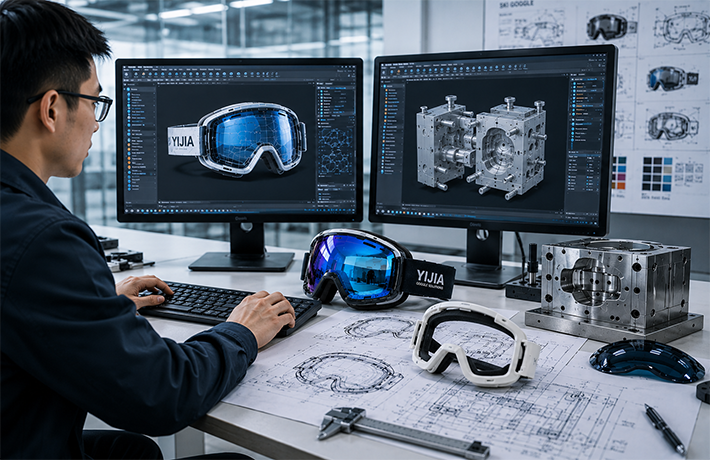
OEM, or Original Equipment Manufacturing, generally refers to producing goods according to specifications provided or approved by a customer. Those specifications may include dimensions, materials, colors, branding, packaging, and functional requirements. The exact scope depends on the agreement between the brand and manufacturer.
A useful distinction exists between simply adding a logo to an existing item and developing a customized product. Logo printing may require limited modification, while a new frame shape, lens configuration, or packaging format can involve additional development work. Treating both situations as the same type of OEM project can create unrealistic expectations about cost and production schedules.
Product ownership and manufacturing responsibility should also be discussed clearly. A customer may own its artwork, branding, or original design, while the factory handles tooling, processing, assembly, and quality inspection. Written specifications help both sides understand which elements are supplied by the customer and which are developed or produced by the manufacturer.
A customize Ski goggles project can begin with something as simple as a preferred color combination, but more extensive requests may affect multiple manufacturing stages. Frame geometry, lens shape, foam configuration, strap details, surface finishes, and packaging can each require separate consideration before production starts.
Our custom branding solutions at YIJIA include dedicated design support, custom molds, color and packing options, and prototype development. These services are useful when a brand has a visual concept but needs help turning it into a manufacturable product. The important point is that customization should be discussed in terms of actual production requirements rather than treated solely as an aesthetic exercise.
Prototyping also has a practical purpose. A prototype gives both sides an opportunity to examine proportions, appearance, fit, component relationships, and other agreed details before larger quantities are produced. Changes made during this stage are generally easier to manage than revisions introduced after mass production has already begun.
Before approving an OEM order, brands should establish a clear specification sheet. Materials, dimensions, colors, lens requirements, logos, packaging, quantities, and inspection criteria can all be documented so that the approved version has a consistent reference point throughout production.
The same principle applies to custom sports glasses. If the project involves several frame colors or lens variations, each version should have its own identifiable specification. Small differences that seem obvious during a conversation can become ambiguous once multiple versions enter production, particularly when artwork and packaging are handled separately.
Production volume deserves attention as well. A prototype and a bulk order involve different manufacturing considerations. Tooling investment, minimum quantities, component purchasing, production scheduling, and inspection arrangements may change as order volume increases. A factory offering scalable production should be able to explain how these factors affect the project.
Not every manufacturer uses the term OEM in exactly the same way, so customers should examine the actual services behind the label. Design assistance, mold development, sampling, production, packaging, and quality control indicate a broader manufacturing process than simple product decoration.
A genuine OEM partner should also be able to map its production capabilities to the standards required by the destination market. For tactical eyewear, this may mean demonstrating compliance with ANSI Z87.1 and MIL-PRF-32432A for the U.S., or EN ISO 16321-1:2022 for European buyers. This level of specificity separates a manufacturer from a decoration workshop.
At YIJIA Optical, we support projects from concept development through mass production, with options for custom molds, colors, packaging, prototypes, and production scaling. Our role in an OEM project is not simply to reproduce an image; we work through the manufacturing details needed to turn an approved concept into a repeatable product.
The meaning of OEM becomes much clearer once the conversation moves beyond the acronym. A genuine OEM project can involve design interpretation, material selection, tooling, prototypes, production planning, packaging, and quality control, with the exact combination determined by the customer's requirements. For brands exploring custom sports glasses or other personalized eyewear, asking what a factory actually handles is more informative than relying on the OEM label alone.
Our team at YIJIA Optical approaches these projects through practical development and manufacturing support, helping businesses define the specifications that connect an initial concept with a finished product. That support continues through sampling, tooling validation, and production follow-up, giving brands a clearer path from prototype approval to repeat orders.

