Snow rarely presents a uniform visual surface. Changes in light, terrain texture, and shadow can make a slope appear flatter or more defined than it actually is, which is why lens contrast matters alongside basic optical clarity. For businesses evaluating Ski goggles manufacturers, understanding how contrast-enhancing technology interacts with snow conditions can make product development decisions considerably more informed. At YIJIA Optical, we approach this subject by considering the lens as part of a wider sports-eyewear system rather than treating color or tint as an isolated feature.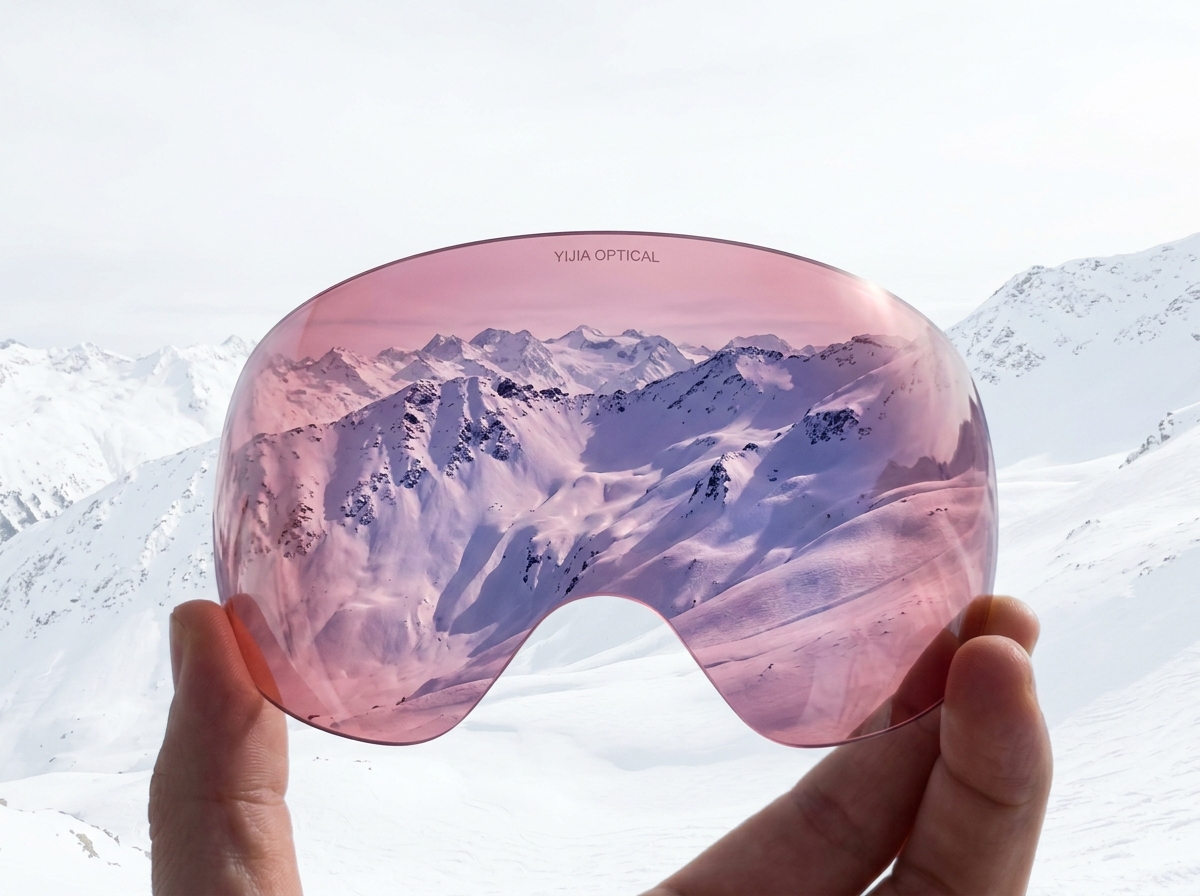
Fresh snow can reflect substantial amounts of ambient light, while uneven terrain creates alternating areas of brightness and shadow. On an overcast day, those differences may become less pronounced, making ridges, depressions, and changes in slope harder to distinguish. A lens that merely reduces glare does not necessarily address every aspect of this visual challenge.
Contrast perception is closely related to how distinctly adjacent areas appear to the eye. If the visual difference between snow and terrain features is weak, small changes in surface elevation may become difficult to identify. Lens design can influence this relationship by selectively filtering or transmitting different wavelengths of light.
For outdoor brands, this distinction is useful because optical performance should be evaluated according to the environment in which the eyewear will be used rather than by a single headline specification.
High-contrast lenses are generally designed to make differences between objects and their surroundings more noticeable. Instead of simply making the scene darker or brighter, a carefully selected spectral profile can influence how differences in the surrounding environment are perceived.
The effect becomes particularly relevant on slopes where terrain changes may be subtle. A skier needs to distinguish variations in snow texture, transitions between illuminated and shaded sections, and the edges of natural or constructed features. The lens cannot create information that is absent, but it can influence how available visual information is presented.
When developing custom sports glasses, we consider factors such as lens material, optical geometry, tint selection, and intended conditions together. That process helps avoid treating a single optical feature as though it determines the entire user experience.
Mountain environments can shift rapidly from bright sunlight to cloud cover. A lens that works comfortably in one lighting condition may feel less suitable after the surrounding illumination changes, particularly if its visible light transmission is highly specific.
Polarized, photochromic, high-contrast, and conventional polycarbonate options each approach outdoor visibility from different directions. Their usefulness depends on the intended activity, lighting environment, and product positioning. There is no universal lens configuration that behaves identically across every skiing scenario.
For Ski goggles manufacturers, this creates an important development question: should a product target a defined weather condition, or should its optical configuration accommodate a broader range of use? The answer influences lens selection, product architecture, and ultimately the market segment being addressed.
A well-defined application profile gives optical engineers a stronger basis for deciding which characteristics deserve priority.
Lens performance does not exist independently from the rest of the goggle. Curvature, frame geometry, ventilation, facial fit, and compatibility with helmets or masks can all influence how the wearer experiences the optical system. Even a sophisticated lens needs a stable and practical surrounding structure.
A broad field of view can be valuable because peripheral information contributes to spatial awareness during movement. Cylindrical and other curved lens geometries can help create wider visual coverage, while frame construction determines how securely that optical area remains positioned during activity.
Our work at YIJIA Optical covers OEM development from R&D through mass production, and we use that broader manufacturing perspective when discussing sports-eyewear concepts. The company states that it has more than 20 years of experience and has completed over 180,000 transactions, supporting its one-stop OEM approach for global sports brands.
These capabilities matter most when optical requirements need to be translated into a manufacturable product rather than remaining as a concept on paper.
Visual testing should reproduce the conditions in which a product will actually be used. Testing only under controlled indoor lighting may provide useful baseline data, yet it cannot fully represent the combination of snow reflection, cloud cover, direct sunlight, movement, and changing terrain encountered outdoors.
For brands considering custom sports glasses, the same principle applies beyond skiing. Cycling, motocross, tactical activities, and other outdoor applications can require different approaches to contrast, glare control, color perception, and field of view. A lens specification should therefore be connected to the intended activity instead of being selected solely because a particular feature sounds advanced.
At YIJIA Optical, these requirements can be considered during development and carried through sampling and mass production. That perspective is especially relevant to businesses that want their eyewear to reflect a particular use case, visual identity, or customer profile.
The strongest product concepts usually begin with a clear understanding of the visual problem before specific lens characteristics are selected.
Snow contour recognition involves more than making a scene appear bright or dark. The interaction between light transmission, spectral characteristics, contrast, glare, lens geometry, and surrounding frame design determines how useful the visual information becomes during outdoor activity. Brands working with Ski goggles manufacturers can therefore benefit from examining optical technology in relation to actual skiing environments rather than relying on one specification as a shortcut for overall performance.
We take a similar system-oriented approach at YIJIA Optical, where sports-eyewear development can progress from R&D and design through sampling and mass production. High-contrast technology is one part of that process, while the intended conditions, frame construction, lens material, and target user remain equally important. For companies developing custom sports glasses, that broader evaluation can provide a more practical foundation for creating eyewear around genuine outdoor needs.

