Cloud cover changes the way terrain, shadows, and surface contours appear on the mountain, making lens tint an important part of visual comfort. A darker lens is not automatically the better choice in flat light; the goal is to maintain useful contrast while allowing enough visible light to reach the eyes. For polarized Ski goggles, tint selection should also take into account glare, weather, terrain, and the skier’s visual preferences. At YIJIA Optical, we consider lens color and optical performance together when developing eyewear for changing outdoor conditions.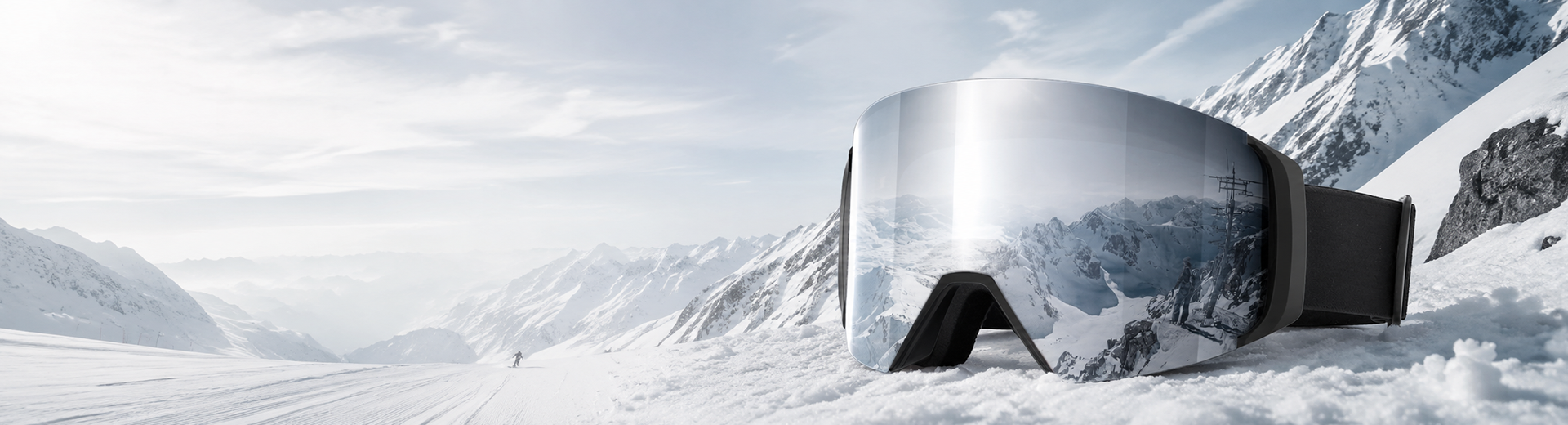
Bright sunshine creates strong differences between illuminated snow and shaded areas, while an overcast sky produces softer and more uniform illumination. Snow can still appear bright, but the reduced directional light may make small variations in terrain harder to distinguish.
Flat light is especially noticeable when slopes contain subtle bumps, dips, or changes in surface texture. A suitable lens should allow enough light through while preserving useful contrast. If the tint is excessively dark, the visual scene may become unnecessarily muted.
Cloudy conditions also vary considerably. A high, thin cloud layer can leave the mountain relatively bright, whereas dense clouds, snowfall, or late-afternoon conditions may reduce visibility much further. Lens selection should reflect these differences rather than treating every overcast day as the same situation.
Yellow, amber, and rose-based tints are commonly associated with low-light or variable-light conditions because they can alter the balance of wavelengths reaching the eye and make certain contrasts more noticeable. Their actual performance depends on the lens construction, transmission level, optical quality, and surrounding conditions.
A gray lens generally maintains a more neutral perception of colors. It can be useful under brighter conditions, but a very dark gray lens may not be comfortable when cloud cover significantly reduces available light. The tint itself is only one part of the optical equation.
Some lenses use high-contrast treatments rather than relying only on visible color. For best skiing goggles, shoppers should look beyond the appearance of the lens and check transmission characteristics, optical clarity, anti-fog performance, and the intended weather range.
Polarization can reduce certain types of reflected glare, particularly glare produced by bright surfaces. Snow and ice can generate substantial reflections, so polarized lenses may provide a different visual experience from conventional lenses under suitable conditions.
However, polarization does not automatically make a lens appropriate for every overcast situation. If the overall lens transmission is too low for the available light, glare reduction does not compensate for insufficient brightness. A cloudy-day lens still needs an appropriate balance between light transmission and visual contrast.
Our Ski-goggle range at YIJIA Optical includes options such as anti-fog lenses, UV400 protection, TPU frames, and multi-layer foam, with lens configurations selected according to the intended application. For polarized Ski goggles, the polarization function should be considered alongside tint, transmission, weather conditions, and the skier’s usual environment rather than evaluated separately.
Weather forecasts provide a useful starting point, but mountain conditions can change rapidly. A skier may move from an exposed ridge under bright cloud cover into a shaded section with snowfall within a short period. A lens suited to one part of the mountain may feel different several minutes later.
Terrain also affects the visual challenge. Open slopes can expose the eyes to more reflected light, while tree-covered areas create stronger differences between bright openings and darker surroundings. Lens selection should reflect the environments in which the goggles will actually be used.
Interchangeable lenses can be particularly practical for people who Ski across a wide range of conditions. Instead of forcing one tint to handle every weather pattern, separate lenses can be matched to brighter, mixed, or low-light conditions. This approach also makes it easier to evaluate each lens according to its intended transmission range.
For ski goggles, EN ISO 18527-1 provides a defined framework for evaluating optical performance and UV protection, which is more meaningful than judging a lens by tint alone. Color alone cannot tell the full story of a goggle lens. Buyers should examine UV protection, optical distortion, anti-fog performance, impact resistance, lens construction, and compatibility with the frame. These factors influence the overall viewing experience and can be more meaningful than appearance alone.
A double-layer lens can help manage the temperature difference between the inner and outer lens surfaces, while an anti-fog treatment or construction can contribute to clearer vision during active use. Fit matters as well because gaps, ventilation, and facial contact influence how air moves around the lens.
For people comparing best skiing goggles, the most suitable option depends on the conditions, rather than a universal tint ranking. A skier spending most of the day in bright alpine sunshine may need a different transmission level from someone who frequently skis during snowfall or heavy cloud.
Cloudy mountain weather does not point to one universally correct lens color. The useful starting point is to consider how much light is available, how strongly the snow reflects it, how much contrast the terrain provides, and whether conditions are likely to change during the day.
We at YIJIA Optical approach Ski-goggle development with these environmental variables in mind, combining lens options with anti-fog performance, UV400 protection, and practical frame construction. Once those factors are considered together, selecting polarized Ski goggles or another lens configuration becomes a matter of matching optical characteristics to the conditions rather than simply picking the darkest or most colorful lens.

